

Dual benefits of agritourism
Leveraging advantages such as extensive agricultural land, a network of river islets and specialized fruit-growing zones, many farmers in Can Tho have boldly combined agricultural production with experiential tourism. This agritourism model not only generates additional income and expands market outlets for agricultural produce but also creates jobs, especially for female workers, while enriching local tourism product offerings.
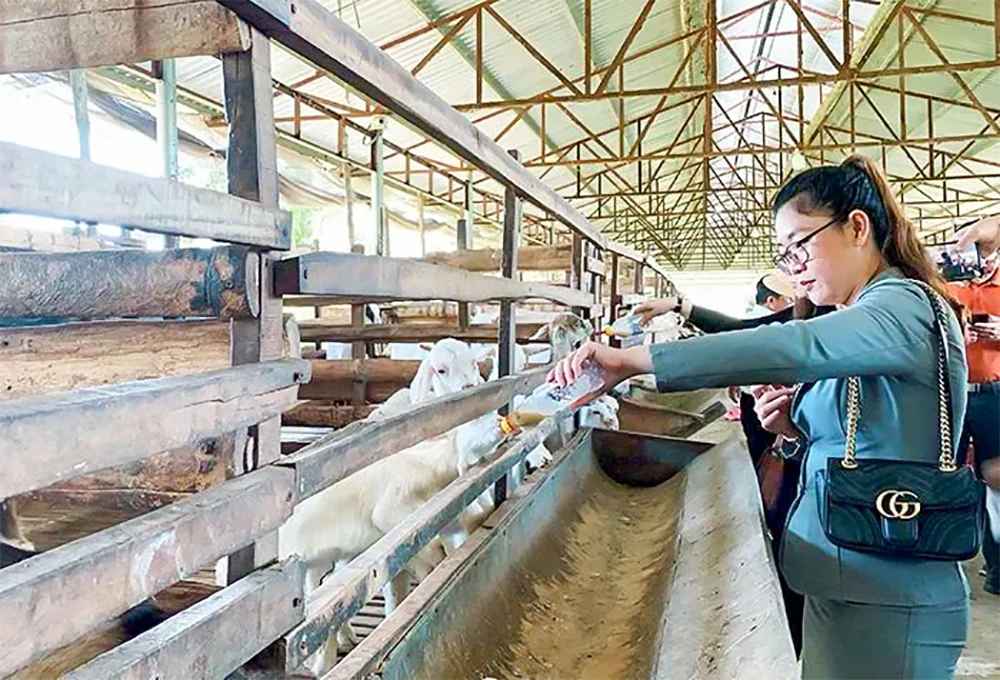
Visitors experience bottle-feeding goats at Ngoc Dao Goat Milk Farm.
When farmers become tourism operators
Ms. Dang Thi Ngoc Dao, owner of Ngoc Dao Goat Milk Farm (Tan Hoa commune), transitioned from raising goats for meat to a model focused on dairy production and experiential tourism.
Ms. Dao said: “My family initially raised goats for meat, then gradually switched to goat dairy farming and integrated tourism activities. This shift has helped stabilize our finances”.
The Saanen goat herd, which started with just over a dozen animals, has now grown to over 300, becoming a large-scale dairy farming model in the area.
The facilities are designed to be well-ventilated and scientifically divided into sections, allowing visitors to directly participate in caring for, feeding and milking the goats, as well as learning about the processing stages.
Currently, the farm not only supplies goat milk and breeding stock but also welcomes visitors to experience the farming, milking and processing of goat milk products. From this source of raw materials, the family has built a brand with 6 five-star OCOP products.
Much like in Tan Hoa commune, many households on Con Son islet (Binh Thuy Ward) are effectively leveraging their agricultural assets to develop community-based tourism models.
Ms. Phan Kim Ngan, Director of Con Son Agricultural Tourism Cooperative, noted that local residents previously relied primarily on agriculture, leading to an unstable livelihood. Since 2015, households have collaborated to develop tourism, leveraging their orchards, fish ponds, and traditional crafts to create offerings for visitors.
“Initially, only a few households were involved in tourism, but that number has now grown to several dozen, resulting in a marked improvement in economic outcomes”, Ms. Ngan said.
Each family on Con Son Islet offers a signature product for visitors, such as orchard tours, traditional cake making, local culinary experiences and unique activities rooted in rural life, creating a diverse range of offerings with minimal overlap.
Ms. Bui Thuy Lieu, a member of Con Son Agricultural Tourism Cooperative, said that her family’s livelihood previously mainly depended on the pomelo orchard, and life was difficult. After participating in tourism and acquiring skills in customer service, promotion and product development, her family's income has gradually stabilized. Her tourism site currently welcomes between 250 and 300 visitors weekly, offering experiences such as fruit orchard tours, "duck massages" and local cuisine.
According to Ms. Lieu, engaging in tourism has not only boosted income but also shifted farmers' mindsets, teaching them how to preserve and promote indigenous cultural values and build brands for local agricultural products.
Toward a sustainable development model
A notable common feature of agritourism models in Can Tho is that most participating households aim for sustainable development.
At Ngoc Dao Goat Milk Farm, the breeding and processing operations are organized as a closed-loop system. The goats' diet consists primarily of grass and quality-controlled agricultural by-products. Each day, the farm processes between 40-60 liters of milk to produce fresh milk, yogurt, cheese, freeze-dried yogurt and various other products.
According to Ms. Ngoc Dao, when visitors observe the production process, they gain greater confidence in the product quality, thereby becoming long-term customers and helping to promote the brand.
Similarly, Cu Lao Dung Ecological Agriculture and Community-based Tourism Cooperative is developing tourism linked to eco-agriculture.
Ms. Pham Thi Thuy Diem, a cooperative member, said: “We engage in tourism while helping local residents, especially women, secure sustainable livelihoods”.
This model also helps promote various local specialties, such as apple mangrove, nipa palm, coconut and sugarcane. Furthermore, the cooperative integrates experiential activities with environmental protection, reforestation and ecosystem preservation.
In reality, agricultural tourism in Can Tho is increasingly developing with diverse models, from family-run destinations to community-based models.
Each model exploits its own strengths, contributing to enhanced agricultural production value, creating jobs, increasing income for people and gradually forming a unique identity for the city's agricultural tourism sector.
AI LAM (Translated by Thanh Truc)