

Can Tho elevates tourism offerings to draw international travelers
The inbound tourism season is kicking off. Facing changing market trends, tourism enterprises in Can Tho are adapting proactively, enhancing service quality, renewing offerings, and leveraging indigenous cultural values to attract visitors and sharpen their competitive edge.
Adapting to the market
Ms. Pham Thi Thanh, General Manager of TTC Hotel Can Tho, said this year's inbound season poses many challenges for the city's tourism sector amid major market adjustments.
The ongoing tensions in the Middle East have directly affected operations at major aviation hubs, leaving many Europe - Vietnam connecting routes still short of a full recovery. This has driven up costs and reduced flight frequency, impacting European and American markets, which have traditionally been a key source of international visitors for Can Tho.
In addition, shifts in traveler preferences, with demand for more “off-the-beaten-path” experiences, have also affected visitor arrivals. At TTC Hotel Can Tho, actual guest numbers are currently falling by around 15-19%.
Ms. Pham Thi Thanh outlined the solution: “This is the time for businesses to pivot from pursuing growth in numbers to increasing value for each guest. TTC Hotel Can Tho is actively broadening its reach into Northeast Asian and ASEAN markets, as well as the bleisure travel segment. At the same time, the hotel is developing in-depth experience chains centered on culture and ecology, encouraging visitors to stay longer in Can Tho”.
From a tour operator’s perspective, Mr. Ngo Minh Duc Uy, Inbound Development Director at Mekong Smile, noted that the international tourism season typically runs from October to April of the following year. This year, however, bookings for tours and services appear to be pacing slower.
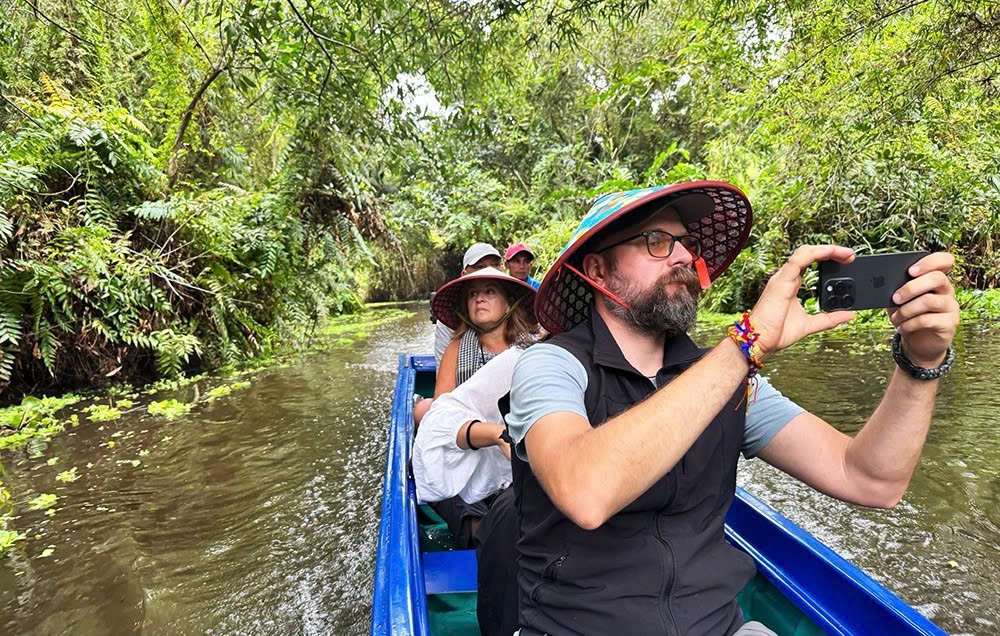
International guests on a familiarization trip with Mekong Smile's products. Photo: Mekong Smile
According to Mr. Ngo Minh Duc Uy, most international visitors to the Mekong Delta in general and Can Tho in particular come from Europe and the US; they prefer long stays and are eager to discover local culture and experience life on the river. This segment is willing to pay higher prices if the product matches the quality and experiential value. Meanwhile, Can Tho's tourism products and services remain uneven across segments, which affects the destination's ability to attract and retain visitors.
Promoting local cultural values
Based on market analysis and exchanges with leading tour operators and international partners, Mekong Smile is building a new product line aimed at attracting visitors to Can Tho. Mr. Ngo Minh Duc Uy said: “The product, called Heritage Boat, taps into the cultural heritage of life on the river. In the initial phase, it will focus on developing new, in-depth experiences at the floating market and along the canal network, especially smaller canals”.
According to Mr. Ngo Minh Duc Uy, Can Tho now has a wide range of products serving international visitors, spanning from premium to standard segments. However, the premium segment is priced quite high, while some standard offerings still fall short of meeting visitors' expectations for meaningful experiences. As such, “Heritage Boat” targets the mid-range segment, offering reasonable pricing and a richer variety of activities.
Built on the foundation of riverine cultural heritage, the product connects craft villages, local culture and agricultural activities at the destination. Mekong Smile is currently introducing the product to tour operators and international partners for a familiarization trip, collecting feedback for ongoing improvement.
Mr. Uy noted that a new tourism product usually requires 1-2 years of surveying and evaluation before being adopted by the international market and commercially launched. Despite this, “Heritage Boat” has garnered encouraging initial feedback and is anticipated to welcome its first tour groups in 2027.
Meanwhile, Mekong Silt Ecolodge has chosen to tap into a niche market, targeting senior travelers from Germany, the Netherlands and France who are looking for long-stay wellness retreats in Can Tho and the Mekong Delta. Ms. Huynh Thi Bich Tuyen, Director of Mekong Silt Ecolodge, said: “This guest segment's stay can last from 10-30 days. They have a particular fondness for slow living, authentic daily life experiences and natural spaces”.
With this in mind, Mekong Silt Ecolodge has not only built an eco-friendly retreat space but also woven the everyday life of local people into its experiential activities. Visitors can join local countryside markets, row small boats, cycle to attend death anniversaries and weddings in the countryside, or join residents in the garden to pick vegetables, catch fish, collect snails and prepare meals.
This approach has initially yielded positive results. According to Ms. Huynh Thi Bich Tuyen, Mekong Silt Ecolodge is fully booked until April 2027, with some guests having already booked for 2028. Furthermore, the establishment plans to revitalize selected traditional occupations to showcase to visitors. International tourists, especially those from Europe, the US and more recently Israel, show strong interest in Mekong culture, spanning river life, craft villages and local gastronomy. The revitalization of traditional occupations not only diversifies the product offering but also contributes to showcasing indigenous culture via authentic experiences.
In conjunction with external experiential offerings, TTC Hotel Can Tho also emphasizes the refurbishment of lodging spaces and the diversification of services. Ms. Pham Thi Thanh, General Manager of TTC Hotel Can Tho, stated that the establishment is currently upgrading its facilities to create a modern, elegant resort space with distinct Mekong eco-features, enabling guests to experience the unique charm of Tay Do right at the hotel.
Notably, the hotel integrates indigenous culture into its in-house activities. Guests can take part in hands-on preparation of traditional delicacies such as banh xeo (crispy Mekong crepes), banh khot (mini savory pancakes), banh tet (cylindrical sticky rice cakes) wrapping, or explore the culture by tailoring miniature ao dai (traditional long tunics) and ao ba ba (traditional Southern silk ensembles). Thereby, visitors can enjoy premium lodging services while gaining distinctive cultural experiences unique of the Mekong Delta.
TTC Hotel Can Tho is also oriented towards sustainable development. Recently, the hotel was certified by the Mekong Delta Tourism Association as a Green Tourism Destination of the Mekong Delta. Ms. Pham Thi Thanh added: “At a time when international tourists are increasingly demonstrating sincere interest in green lifestyles and responsible tourism, this green certification serves as a rustic yet credible testament to our commitment to the environment and the celebration of indigenous cultural values”.
Amid fluctuations in the international tourist market, tourism enterprises in Can Tho are actively looking for suitable directions, ranging from market expansion, new product development to service quality enhancement and the in-depth exploitation of indigenous culture. These efforts not only aim to attract more visitors but also help diversify tourism offerings, enhance competitiveness and build a sodid foundation for the sustainable growth of the city's tourism sector.
AI LAM (Translated by MAI QUYEN)