

Can Tho City promotes green processing from rice and biomass
A chain of rice processing plants and biomass fuel supply facilities has recently commenced construction in Dong Hiep Commune, Can Tho City. The project is expected to advance clean agriculture and boost farmers' income. This project chain is oriented toward the development of green rice production and the recovery of by-products, paving a sustainable path for agriculture in the Mekong Delta.
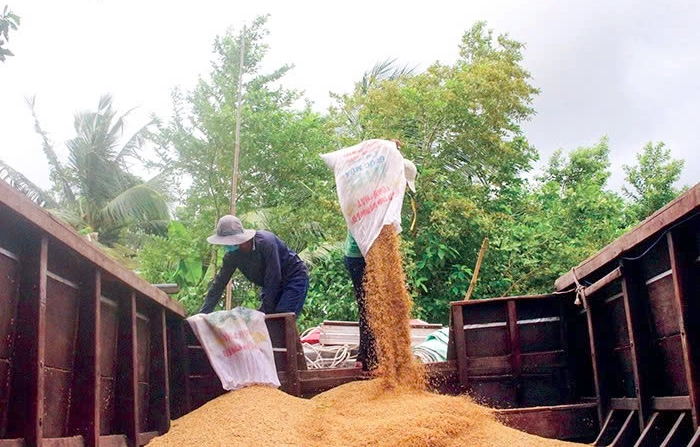
Rice traders buy paddy from farmers in Can Tho City.
Great expectations
The Mekong Delta is the national rice bowl, accounting for over 24 million tons of paddy and approximately 7 million tons of rice exports a year. However, the regional rice industry remains constrained by weak chain integration, inconsistent quality, high post-harvest losses and suboptimal utilization of by-products, resulting in rice farmers' income remaining lower than those of other crop producers.
Mr. Nguyen Minh Tuan, Director of Green CT Joint Stock Company (Green CT - Dong Hiep Commune, Can Tho City), said: “We are always thinking about how every grain of paddy can not only generate high value for the enterprise, but first and foremost, improve farmers' lives and contribute more to the locality. From that mindset, Green CT is oriented towards building a closed-loop and sustainable value chain from farmers' fields, cooperatives and companies engaged in procurement, processing and export of rice”.
According to Green CT, paddy is procured and processed into export-grade, high-value rice. At the same time, in the processing stage, rice husk - formerly a low-value by-product - is now recovered and transformed a high-value economic resource.
Mr. Nguyen Minh Tuan further noted: “Via long-term collaboration with EREX of Japan, post-milling rice husk will be used to fuel biomass power production. We recognize that resource circularity is an initial step in initiatives contributing to a sustainable society, capable of generating clean energy, adding value to agricultural resources, creating jobs, reducing emissions, and establishing a circular economy model directly on the agricultural lands of Can Tho and the Mekong Delta”.
Adding value to the chain
According to the Department of Agriculture and Environment of Can Tho City, the city is developing clean and renewable energy, strengthening its role as a regional energy hub. For biomass power, having a plant and advanced technology is just one factor. Nevertheless, to operate sustainably, it needs a fuel source that is stable in volume, quality, price and year-round supply capacity. Therefore, the city is facilitating connections and encouraging investors to develop a rice processing chain integrated with biomass fuel supply. This is a highly meaningful linkage between local agricultural strengths and the locality's needs for industrial and energy development”.
Green CT recently held a groundbreaking ceremony for the construction of a chain of rice processing plants and a biomass fuel supply center in Dong Hiep commune. Among them, Green CT's rice processing chain comprises five plants. The plant in Dong Hiep commune has a daily capacity of 750 tons of finished rice, yielding approximately 250 tons of husk at full operational capacity. With the chain of processing plants and the Biomass Fuel Supply Center, Green CT seeks to establish a closed-loop and sustainable value chain. Once operational, the project will not only apply advanced technologies to enhance the rice grain value chain and meet the stringent standards of international markets, but also establish an exemplary circular economy model. By utilizing by-products from rice to produce fuel, Green CT contributes to the net-zero emission targets of Can Tho City and the Mekong Delta region.
According to Green CT, once the plant chain is operational, it will extend the value of the rice plant: rice for consumption and export, while by-products being sorted, processed and put to appropriate use, with rice husk turned into a fuel source for energy production. This added value is generated locally, along with job creation, transportation services and growth opportunities for enterprises, cooperatives and products within the circular production chain.
Mr. Le Cong Ly, Standing Vice Chairman of the People's Committee of Can Tho City, stated: “What the city expects from this project chain is to establish a new production organization model that helps better exploit the rice plant's value, raises farmers' income and creates a stable feedstock for the energy sector. This is also a concrete step to put Can Tho's green development orientation into practice. The city has assigned the Department of Agriculture and Environment and relevant departments and agencies to assist in linking raw material areas, cooperatives and low-emission production processes; connecting fuel demand, processing industries and energy projects... Green CT must secure resources, organize construction on schedule and safely; build its feedstock area through substantive linkages; honor its commitments; be transparent in cooperation, fulfill its responsibilities well to cooperatives and farmers, and ensure environmental protection”.
HA VAN (Translated by MAI QUYEN)